


 June 7, 2026
Artificial intelligence is no longer a futuristic concept. It has become an integral part of how businesses operate, how consumers search for information, and how marketers analyze data and make decisions. From content creation and research to customer support and reporting, AI-powered tools are rapidly transforming workflows across industries.
As AI adoption continues to grow, one question is becoming increasingly important: Where do AI tools get their information?
Many users assume that AI systems simply “know” everything. In reality, every AI platform relies on specific data sources, training methods, and retrieval mechanisms to generate responses. Understanding these sources is essential, particularly for marketers, business owners, researchers, and decision-makers who depend on AI-generated insights to support business strategies.
While AI can significantly improve productivity, it should not replace human expertise, critical thinking, or professional judgment. Data, statistics, trends, and case studies generated by AI should always be evaluated within the context of industry knowledge and experience.
So, how do modern AI tools gather and process information?
Understanding the Two Main Sources of AI Data
Most AI platforms obtain information through two primary methods:
1. Training Data
Training data refers to the large collections of information used to teach an AI model before it becomes available to the public. These datasets may include:
- Public websites
- Books and publications
- Research papers
- Documentation
- News articles
- Computer code repositories
During training, AI systems learn patterns, language structures, relationships between concepts, and problem-solving techniques. However, this information is static, meaning it reflects the data available at the time the model was trained.
2. Real-Time Data Retrieval
Some AI platforms can access current information by searching the internet in real time. Instead of relying solely on prior knowledge, these systems actively retrieve up-to-date information from search engines, databases, or connected platforms.
This capability is particularly important when users need:
- Breaking news
- Current market trends
- Recent statistics
- Live events
- Updated regulations
- Latest industry developments
The balance between training data and real-time retrieval varies significantly among AI platforms.
ChatGPT (OpenAI)
How It Gets Data
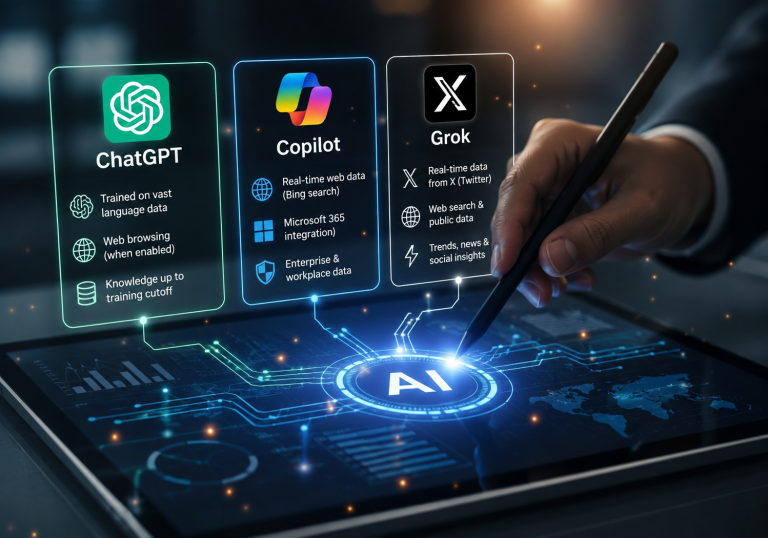
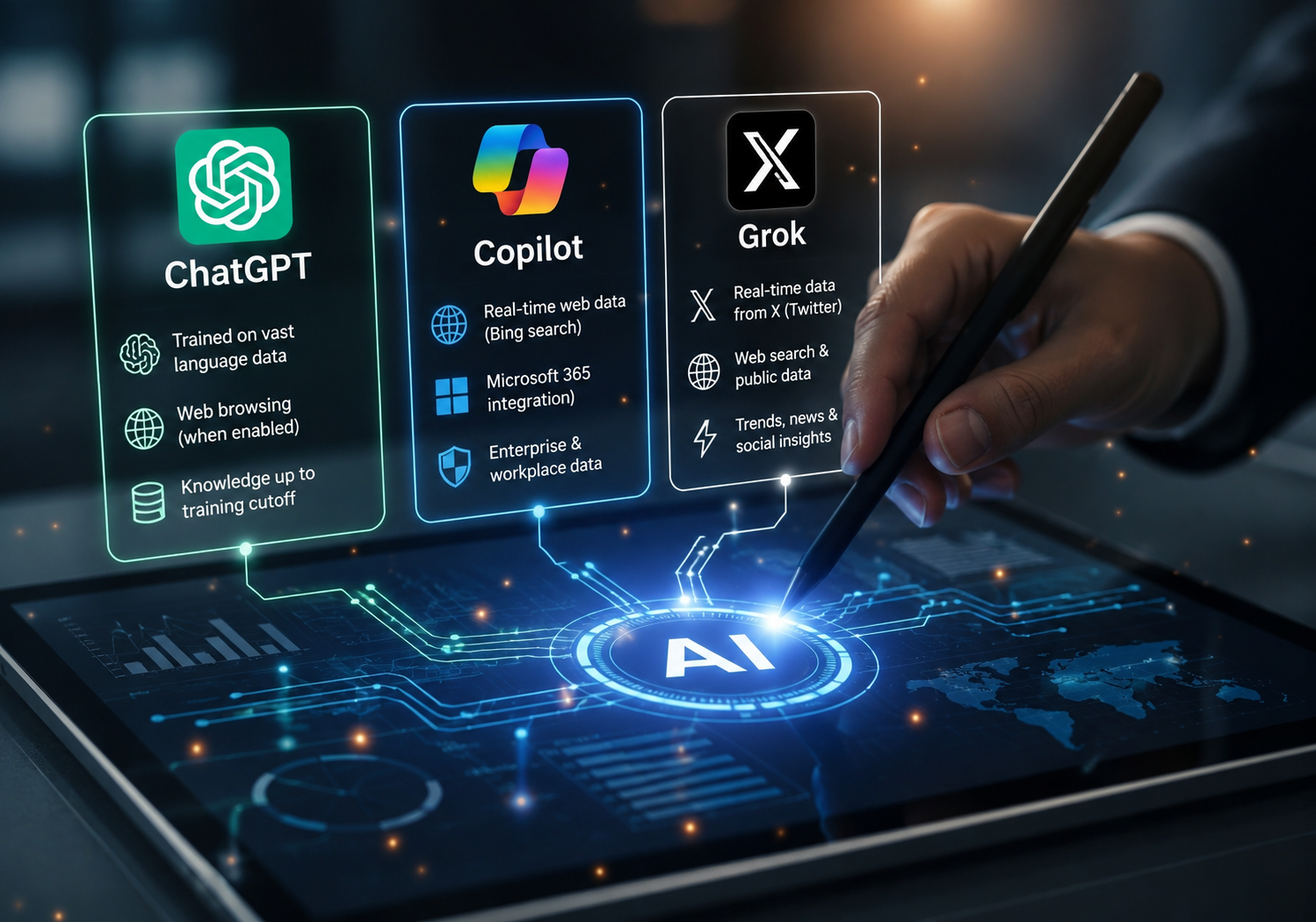
ChatGPT is primarily built on extensive training datasets containing information from publicly available text, books, websites, documentation, and code repositories. During training, the model learns how language works and how concepts relate to one another. Rather than searching the internet every time a question is asked, ChatGPT typically generates responses based on patterns and knowledge learned during training.
Real-Time Capabilities
Modern versions of ChatGPT can also perform web searches when browsing or research features are enabled. This allows the platform to retrieve current information when needed.
For historical explanations, strategic guidance, and general knowledge topics, ChatGPT often relies on its trained knowledge base. For current events or time-sensitive information, it can supplement responses with live web data.
Data Strategy
One notable development in OpenAI’s approach is the increasing use of synthetic data. This involves AI-generated training examples that help improve reasoning, problem-solving, and language understanding.
For marketers, ChatGPT is particularly effective for:
- Content creation
- SEO planning
- Data interpretation
- Strategy development
- Workflow automation
- Research summaries
However, important business decisions should still be validated through reliable sources and professional expertise.
Perplexity AI
How It Gets Data
Perplexity operates differently from traditional AI assistants. It functions more like an AI-powered research engine than a standalone language model. When a user submits a query, Perplexity actively searches the web through various search engine integrations and data sources. It then analyzes the results and generates a summarized response.
Real-Time Capabilities
One of Perplexity’s biggest strengths is its ability to retrieve current information quickly.
Unlike systems that primarily rely on training data, Perplexity is designed to gather fresh information from the internet and present it in a conversational format. A key advantage is its citation system, which allows users to see the sources behind many of the claims being presented.
Data Strategy
Perplexity’s focus on live information makes it particularly useful for:
- Industry research
- Competitive analysis
- Market trends
- News monitoring
- Academic research
For marketers, the ability to verify information through cited sources can be extremely valuable when preparing reports or validating data.
Microsoft Copilot
How It Gets Data
Microsoft Copilot combines OpenAI’s language models with Microsoft’s extensive technology ecosystem.In addition to leveraging advanced AI capabilities, Copilot integrates with Microsoft’s Bing search engine to retrieve real-time information from the web.
Real-Time Capabilities
Copilot’s real strength lies in its connection to the Microsoft ecosystem.
When used within Microsoft 365 environments, Copilot can access and analyze organizational data stored in:
- Outlook
- Word
- Excel
- PowerPoint
- Teams
- SharePoint
This enables users to generate insights based not only on public web information but also on their own business data.
Data Strategy
For businesses already invested in Microsoft technologies, Copilot provides significant advantages by combining AI capabilities with workplace productivity tools.
Common use cases include:
- Report generation
- Data analysis
- Meeting summaries
- Internal documentation
- Business intelligence
Its ability to work with organizational data makes it particularly valuable for enterprise environments.
Grok (xAI)
How It Gets Data
Grok, developed by xAI, takes a different approach compared to many other AI platforms.
Its most distinctive feature is its direct integration with X (formerly Twitter), giving it access to a massive stream of public conversations and user-generated content.
Real-Time Capabilities
Because of its connection to X, Grok excels at identifying:
- Breaking news
- Trending discussions
- Public sentiment
- Industry conversations
- Crypto and Web3 developments
This allows it to provide insights based on what people are discussing in real time.
Data Strategy
Grok’s training and retrieval methods are heavily influenced by social media activity and public discourse.
For marketers, this can be useful when monitoring:
- Consumer sentiment
- Brand conversations
- Viral trends
- Emerging topics
- Public reactions
However, because social media information can sometimes be inaccurate or biased, additional verification is often necessary.
The Most Important Takeaway for Marketers
While AI tools are becoming increasingly sophisticated, no platform should be treated as a single source of truth. Each tool has strengths and limitations based on where it obtains its information.
ChatGPT excels at reasoning and content generation. Perplexity shines in research and citations. Copilot offers powerful business integrations. Grok provides valuable access to real-time social conversations.
For marketers, analysts, and business leaders, the most effective approach is not choosing one AI platform over another. Instead, it is understanding how each tool gathers information and using the right platform for the right task.
AI can accelerate research, improve efficiency, and uncover insights faster than ever before. However, experience, industry expertise, and critical thinking remain essential. The most successful professionals will be those who combine AI-powered intelligence with human judgment to make informed decisions and develop effective strategies.
